

As investors, we often spend disproportionate time analyzing potential yield. We look at the upside, the interest rate, and the monthly cash flow. These are important metrics, but they are secondary to the primary goal of any prudent investor: Capital Preservation.
 If you have ever felt a knot in your stomach when deploying significant capital, it is likely because of the “what if.” What if the economy turns? What if the borrower defaults? In the world of fixed-income alternative investments, your security isn’t defined by promises made when times are good; it is defined by the legal framework and underwriting intelligence that protects you when things go wrong.
Traditionally, the “First Position Trust Deed” has been hailed as the only true defense. But at Fidelis, we understand a deeper truth: Not all 2nd Trust Deeds are created equal. While position matters, structure and strategy matter more.
The Hierarchy of Debt: Understanding Seniority
Real estate debt is structured in a hierarchy. Think of it as a line. The entity at the front of the line (the 1st position) gets paid first from the proceeds of a sale or foreclosure. Historically, being in 2nd position is viewed as “standing behind” the leader, waiting for crumbs.
Most lenders lump all 2nd Trust Deeds into a “high-risk” bucket and dismiss them entirely. We see this as a market inefficiency. By applying sophisticated underwriting, a smart lender can capture a higher yield (a risk premium) without actually increasing the net risk to the investor’s principal.
The Fidelis “2nd as a 1st” Strategy
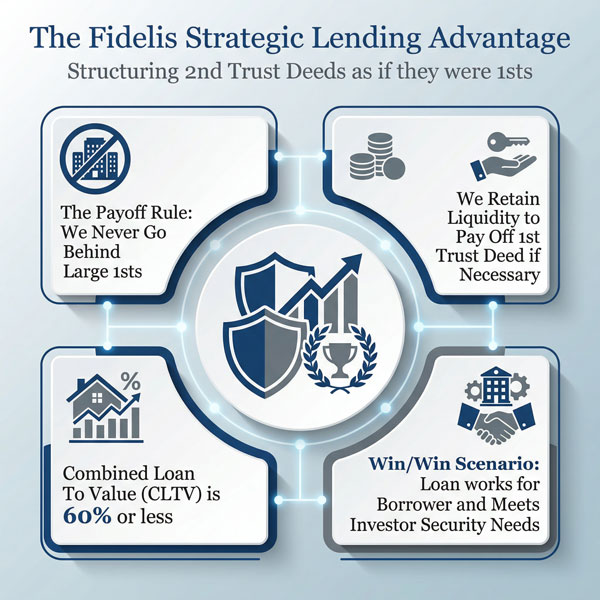 While the majority of our portfolio consists of 1st positions, we don’t eliminate 2nd-position loans solely because of their rank. Instead, we use our management experience—which includes successfully navigating the Great Recession without losing a dime of investor capital—to structure 2nd Trust Deeds as if they were 1sts.
Our criteria for a 2nd Trust Deed are non-negotiable:
- The “Payoff” Rule: We never go behind a large 1st mortgage. We only fund 2nd positions behind small 1st DOTs that Fidelis has the liquidity to pay off immediately to protect our interest if necessary.
- Identical LTV Standards: The Combined Loan-to-Value (CLTV) of both the 1st and 2nd must be the same ratio we would require if we were providing the entire loan ourselves.
- The Win/Win Scenario: It must benefit the borrower’s math and the lender’s security.
A Typical Scenario: Protecting the Low-Rate Advantage
Consider a borrower with an investment property valued at $1,000,000. They have an existing 1st Trust Deed of $400,000 at a 3% interest rate. They want to pull out $500,000 to build two ADUs, which will increase the property value to $1,800,000.
Most lenders would force the borrower to refinance the entire $900,000 into a new 1st position, killing their 3% rate. At Fidelis, we see the inefficiency here.
- We would provide a $500,000 2nd Trust Deed.
- The total debt is $900,000 against an $1.8M value—a 50% CLTV.
- Because we are in 2nd position, we can charge a higher interest rate, generating a higher yield for our investors.
From a risk standpoint, a 50% LTV is a 50% LTV, whether it’s one loan or two. Because the 1st is small ($400k), Fidelis can easily step in and pay it off to take full control of the asset if needed. We achieve 1st-position security with 2nd-position returns.
Precision in Underwriting
Fidelis directly originates and rigorously underwrites every loan. We do not rely on others to assess risk; we meet the borrowers, evaluate the exit strategy, and analyze the collateral ourselves.
Once funded, we utilize specialized third-party servicing for day-to-day administration. This ensures professional segregation of duties, while Fidelis retains total control over the “driver’s seat”—the ability to act swiftly and decisively.
Your Best Defense
 Whether in 1st or a strategically structured 2nd, our goal is a manageable, defined legal process where we hold the controls. We take advantage of market gaps to ensure our investors aren’t just following a “rule of thumb,” but are instead following a proven strategy for growth and protection.
If you are an accredited investor looking for fixed income but want a manager who understands how to navigate market inefficiencies safely, I invite you to start a conversation. I answer my own phone, and I’d love to discuss how we protect our partners.
John Lloyd
Direct: 760-258-4486
Email: jlloyd@fidelispf.com
See Our Latest Performance Report
 Fidelis Private Fund annualized yield paid to Limited Partners for the 4th Quarter 2025. Click here for a summary of Fidelis’s annualized yield since inception.
 Fidelis 2028 Vivid Vision – Where are we going and how are we going to get there!
The Fidelis 2028 Vivid Vision document provides a comprehensive blueprint of the company’s strategic direction, core values, and operational principles, highlighting its commitment to capital preservation, growth, innovation, and client-centric services. Click to read the Fidelis vision.