

We have all felt it. It’s that knot in your stomach when you read the headlines about private credit problems or a sudden liquidity crunch. It’s the realization that while the numbers on a balance sheet might look healthy, the accessibility of your capital is what truly matters when the tide goes out.
In the world of private lending and real estate investment, the conversation almost always starts with Loan-to-Value (LTV). And for good reason—LTV is the bedrock of collateral. It is the equity cushion that protects the lender if a borrower stumbles. But as we have seen in recent market cycles, LTV is not a silver bullet. It is a snapshot in time, and snapshots can change.
For the accredited investor prioritizing capital preservation, LTV is necessary, but it is not sufficient. To truly sleep well at night, you need to look beyond the collateral and examine the structural integrity of the fund itself. You need to ask: What happens between the loan origination and the payoff? What reserves exist to absorb a shock?
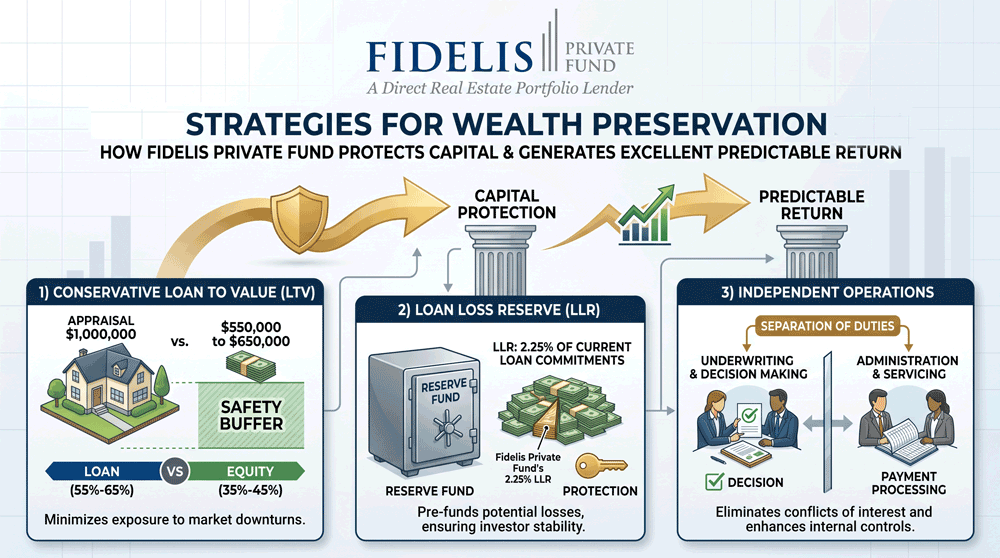
The Secondary Shield: Loan Loss Reserves
Most private funds operate on a simple “money in, money out” basis. They deploy capital as fast as possible to maximize yield. While this looks good on a spreadsheet during a bull market, it leaves the fund fragile during a downturn.
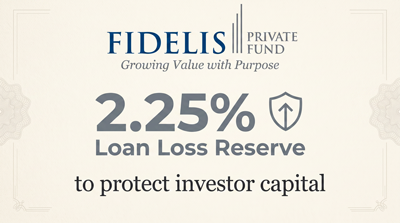 At Fidelis, we view stewardship differently. We believe a fund must possess a structural shock absorber. This is why we maintain a Loan Loss Reserve.
Think of this not as “dead capital,” but as an insurance policy for the fund’s integrity. It is a dedicated allocation of capital set aside specifically to cover potential deficiencies or unexpected delays in loan repayment. By maintaining this reserve, we ensure that the fund’s overall yield and stability remain consistent, even if an individual asset faces a temporary challenge. It turns a potential crisis into a manageable operational detail.
Conservative Cash Management
The fear of a “run on the bank”—or, in our industry, a sudden wave of redemption requests—is typically driven by a fund being illiquid, with 100% of its capital deployed and no additional sources of liquidity to draw on.
We work to keep 100% of investor capital deployed to maximize yield, while still maintaining a cushion for redemptions through a line of credit that never exceeds 20% of our capital—a conservatively low level of leverage. This facility gives us liquidity on demand when investors need to redeem, without disrupting the portfolio. We pair this with disciplined cash management, maintaining enough liquidity to manage fund operations and redemption requests smoothly, so we’re never forced to liquidate assets at fire-sale prices. The result is a structure that delivers both enhanced yield and dependable liquidity when investors need access to their capital. It’s a careful balance, and one we manage with a single goal in mind: protecting investor principal.
Operational Precision: Who Holds the Keys?
 Finally, protection comes down to operational control. In the private lending space, you will often find two extremes: funds that outsource everything and lose touch with the asset, or funds that try to do everything in-house and get overwhelmed.
We take a hybrid approach designed for maximum security and oversight.
Fidelis originates and underwrites every loan. We are the decision-makers. We look the borrower in the eye, we walk the property, and we determine the risk. We do not delegate the decision of where to place your capital.
However, once that loan is made, we utilize a trusted third-party loan servicer to handle the payment processing, tax impounds, and insurance monitoring. Why? Because third-party servicing adds a layer of transparency and professional compliance that protects both the investor and the fund. It ensures that there is a segregation of duties—a crucial guardrail in proper financial management.
A Partnership, Not a Product
Ultimately, fixed income strategies should be boring. They should be predictable. The excitement should come from your life, not your portfolio.
By combining conservative LTVs with loan loss reserves, liquidity management, and third-party servicing, we aim to remove the drama from private lending. We are protecting wealth first, so we can generate yield second.
The best way to understand if this approach aligns with your goals is just to reach out. I don’t hide behind a board of directors or a gatekeeper. I answer my own phone 760-258-4486 and email jlloyd@fidelispf.com. I’d love to hear your story and discuss how we can serve you.
See Our Latest Performance Report
 Fidelis Private Fund annualized yield paid to Limited Partners for the 2nd Quarter 2026. Click here for a summary of Fidelis’s annualized yield since inception.